Housing Mixed, Fed Divided on Next Steps - MBS Highway Weekly Update
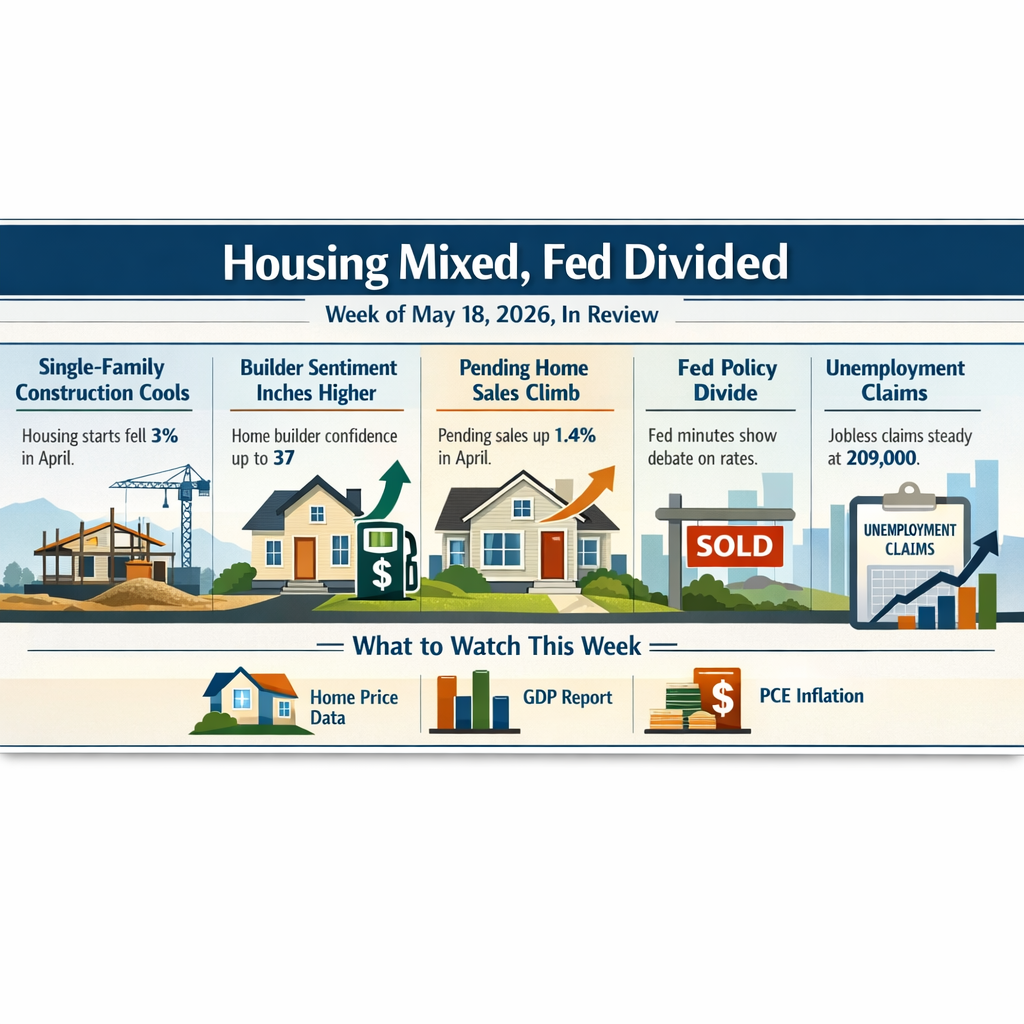
Week of May 18, 2026, in Review April saw a slowdown in single-family housing construction, even as signed contracts for existing homes rose for a third straight month and beat expectations. Meanwhile, the Federal Reserve’s April meeting minutes highlighted disagreement among policymakers over the path forward. Here are the key takeaways.
Single-Family Construction Cools
Housing starts fell nearly 3% from March to April, with most of the decline driven by a pullback in single-family construction. Building permits, a key indicator of future building activity, rose 5.8%, led primarily by multi-family projects as single-family permits declined.
What’s the bottom line?
Overall, the data suggests builders are taking a more cautious approach amid ongoing economic and geopolitical uncertainty.
Builder Sentiment Inches Higher
Home builder confidence ticked up in May, rising three points to 37. While still below the 50 mark that signals expansion, the index showed modest gains in current sales, future expectations, and buyer traffic.
What’s the bottom line?
Higher mortgage rates, rising gas prices, and broader economic uncertainty continue to weigh on demand, according to National Association of Home Builders Chairman Bill Owens. However, potential policy efforts to boost housing supply could help support sentiment going forward.
Pending Home Sales Keep Climbing
Pending home sales, a key measure of signed contracts on existing homes, increased 1.4% from March to April, beating expectations and marking the third consecutive monthly gain. Sales activity was also up 3.2% compared to this time last year. The Northeast and Midwest saw the strongest monthly growth, while activity in the South slowed slightly.
What’s the bottom line?
Despite economic uncertainty and higher mortgage rates, buyers are showing “cautious optimism,” according to Lawrence Yun of the National Association of REALTORS®. Yun added that demand could strengthen even more if mortgage rates move closer to the lower levels seen earlier this year.
Fed Minutes Highlight Policy Divide
The latest minutes from the Federal Reserve’s April meeting, where policymakers left the benchmark rate unchanged as expected, revealed a deeper divide among officials. Governor Stephen Miran continued to favor an immediate rate cut, while some participants pushed to remove any easing bias from the Fed’s statement, even beyond the three who formally dissented.
For context, the Fed’s benchmark interest rate (the Fed Funds Rate) influences borrowing costs across the economy, including mortgages, though it doesn’t set them directly.
What’s the bottom line?
Overall, a “majority of participants” said rate hikes would be appropriate if inflation remains persistently above 2%. At the same time, several argued that rate cuts could be justified if disinflation resumes or the labor market weakens further. The split underscores the Fed’s ongoing balancing act: inflation remains above target, while signs of cooling in the job market and broader global uncertainty keep policymakers cautious.
Pulse Check: Unemployment Claims
New unemployment claims remained relatively low at 209,000, though the figure may not tell the full story of labor market stress. Some workers who have lost their jobs may be turning to freelance or gig work instead of applying for unemployment benefits. At the same time, continuing unemployment claims held at an elevated 1.78 million, a sign that many unemployed workers are still taking longer to land new jobs.
What to Look for This Week
It’s a busy week for economic reports following Monday’s Memorial Day market closure. In housing, watch for home price data from Case-Shiller and the FHFA on Tuesday, followed by New Home Sales on Thursday.
Thursday will also bring the second estimate of first-quarter GDP, the latest jobless claims, and the Fed’s preferred inflation gauge, Personal Consumption Expenditures (PCE).
Technical Picture
Mortgage Bonds moved higher late last week, finishing near the top of their recent trading range. Support remains around 101.39, with resistance near 101.68. Meanwhile, the 10-year Treasury yield broke below a key support level at 4.588% and now has room to move toward the next support area near 4.489%.
All data and analysis provided by MBS Highway.
Contact me anytime to continue the dialogue.
Mike Nelson, CEO - Efficient Lending, Inc 720.419.3016 | mike@efficientlending.net |