Inflation Ticks Higher, Housing Appreciation Forecasts Hold Firm - MBS Highway May 25, 2026 Review
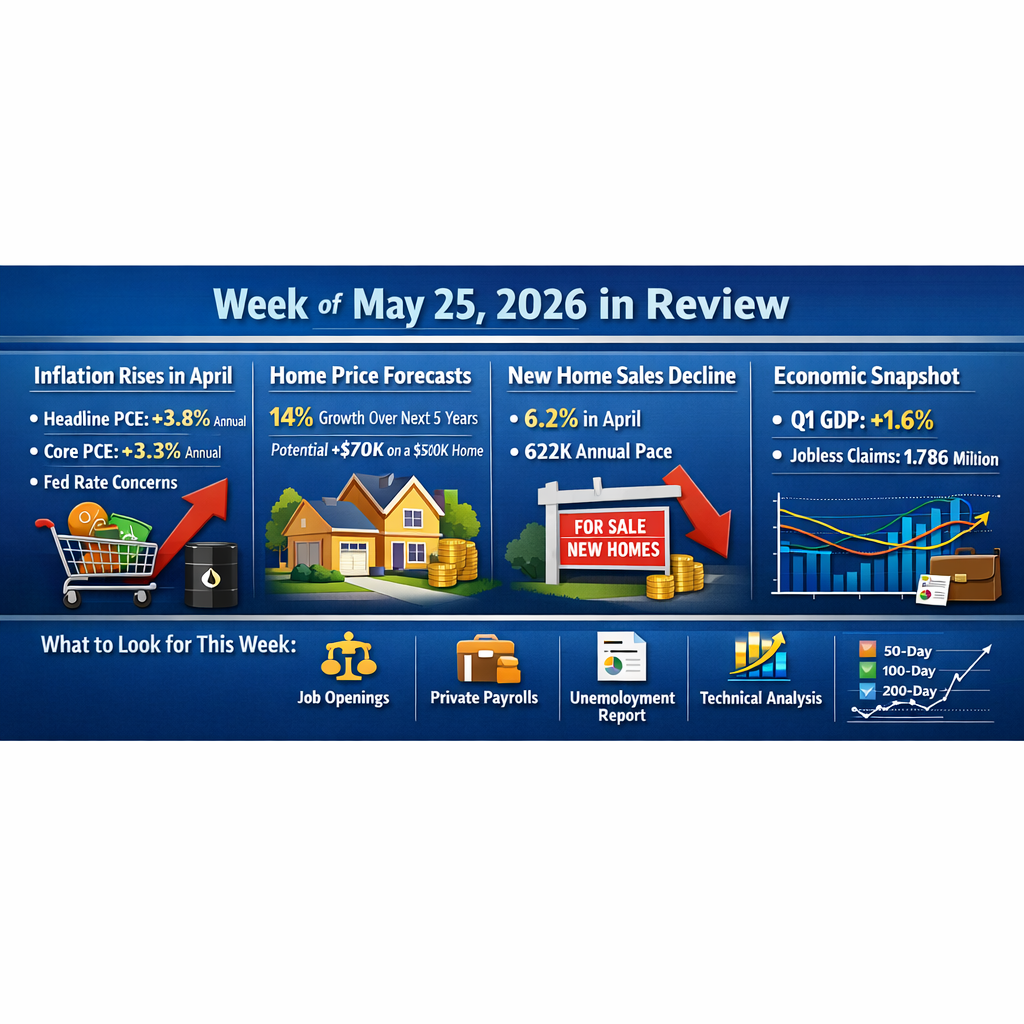
Week of May 25, 2026 in Review Annual inflation moved higher in April, while new home sales came in below expectations. At the same time, long-term home price forecasts continue to reinforce the wealth-building potential of homeownership. Here are the key takeaways.
Inflation Rises in April, Still Above Fed Target
Headline Personal Consumption Expenditures (PCE) rose 0.4% in April, slightly below expectations. On an annual basis, headline inflation increased to 3.8%.
Core PCE – the Fed’s preferred inflation measure, which excludes food and energy prices – rose a more moderate 0.2% for the month, also coming in slightly cooler than forecast. However, the annual core inflation rate edged up to 3.3% from 3.2%, remaining well above the Fed’s long-term 2% target.
What’s the bottom line?
The Federal Reserve continues to balance two competing trends: inflation that remains elevated and signs the labor market may be cooling. More recently, renewed tensions in the Middle East have also kept inflation concerns in focus, particularly given the potential impact on energy prices. Persistent inflation supports the Fed’s cautious stance on interest rate cuts, while softer employment data could strengthen the case for potential easing later this year.
Markets will now be closely watching Fed Chair Kevin Warsh’s first Fed meeting on June 16–17, along with any comments leading up to the meeting, for further insight into the path of future interest rate decisions.
Appreciation Forecasts Highlight Value of Homeownership
According to the latest Case-Shiller Home Price Index, U.S. home prices increased 0.7% from February to March before seasonal adjustments. After adjusting for typical seasonal patterns, prices were down a modest 0.2%. Overall, home values remain 0.7% higher than a year ago.
Separate data from the Federal Housing Finance Agency (FHFA) showed home prices were largely flat month over month on a seasonally adjusted basis, while still posting a solid 1.7% annual gain for homes backed by conventional loans.
What’s the bottom line?
While home price growth has moderated recently, even modest gains can add up over time. Looking ahead, Fannie Mae and Pulsenomics’ latest Home Price Expectations Survey – which reflects forecasts from more than 150 economists, real estate experts, and market strategists – projects cumulative home price growth of 14% over the next five years.
For perspective, a $500,000 home could gain roughly $70,000 in value over that period, underscoring the long-term wealth-building potential of homeownership
New Home Sales Ease
After two months of gains, new home sales declined 6.2% in April to a 622,000 annual pace, coming in below expectations. Sales were also 11.3% lower than a year ago. Because this report tracks signed contracts, it reflects buyers who were actively shopping during April.
What’s the bottom line?
While the monthly decline drew attention, new home sales data can be volatile from month to month. According to Bill Owens, chairman of the National Association of Home Builders (NAHB), higher mortgage rates and elevated gas prices likely weighed on buyer activity in April, even though underlying demand for housing remains.
At the same time, inventory of completed homes remains relatively limited nationwide. Of the 489,000 new homes available for sale, only 122,000 were fully completed and ready for occupancy, while the rest were still under construction or had not yet been started.
Limited move-in-ready supply could continue to support home prices over time. Combined with the long-term appreciation forecasts discussed above, this is one reason housing continues to be viewed by many as a long-term wealth-building asset.
Economic Snapshot: GDP and Unemployment
The second estimate for Q1 2026 GDP showed the U.S. economy grew at an annualized rate of 1.6%, slightly below the initial 2% estimate but higher than Q4’s 0.5% pace, when a government shutdown slowed activity late in the year. First-quarter growth was supported by continued AI-related investment and a rebound in government spending, though stronger imports partially offset those gains.
Meanwhile, initial jobless claims edged up to 215,000, while continuing claims rose by 15,000 to 1.786 million. Low initial claims may indicate some unemployed workers are turning to gig or freelance work, which may not be fully reflected in the data. At the same time, elevated continuing claims suggest many job seekers are still taking longer to find new employment.
What to Look for This Week
This week brings several important updates on the labor market. Job openings data is due Tuesday, followed by private payroll numbers on Wednesday and weekly unemployment claims on Thursday. The spotlight then turns to Friday’s closely watched jobs report, which includes nonfarm payrolls and the unemployment rate.
Technical Picture
Mortgage Bonds have rebounded nicely since May 20, ending the week with support at their 50-day Moving Average and facing resistance at both their 100-day and 200-day Moving Averages. Meanwhile, the 10-year Treasury yield closed the week just below its 25-day Moving Average, trading in a tight range with support at its 50-day Moving Average.
All data and analysis provided by MBS Highway.
Please call, text, or email me anytime to continue the dialogue.
Mike Nelson, CEO - Efficient Lending, Inc 720.419.3016 | mike@efficientlending.net |