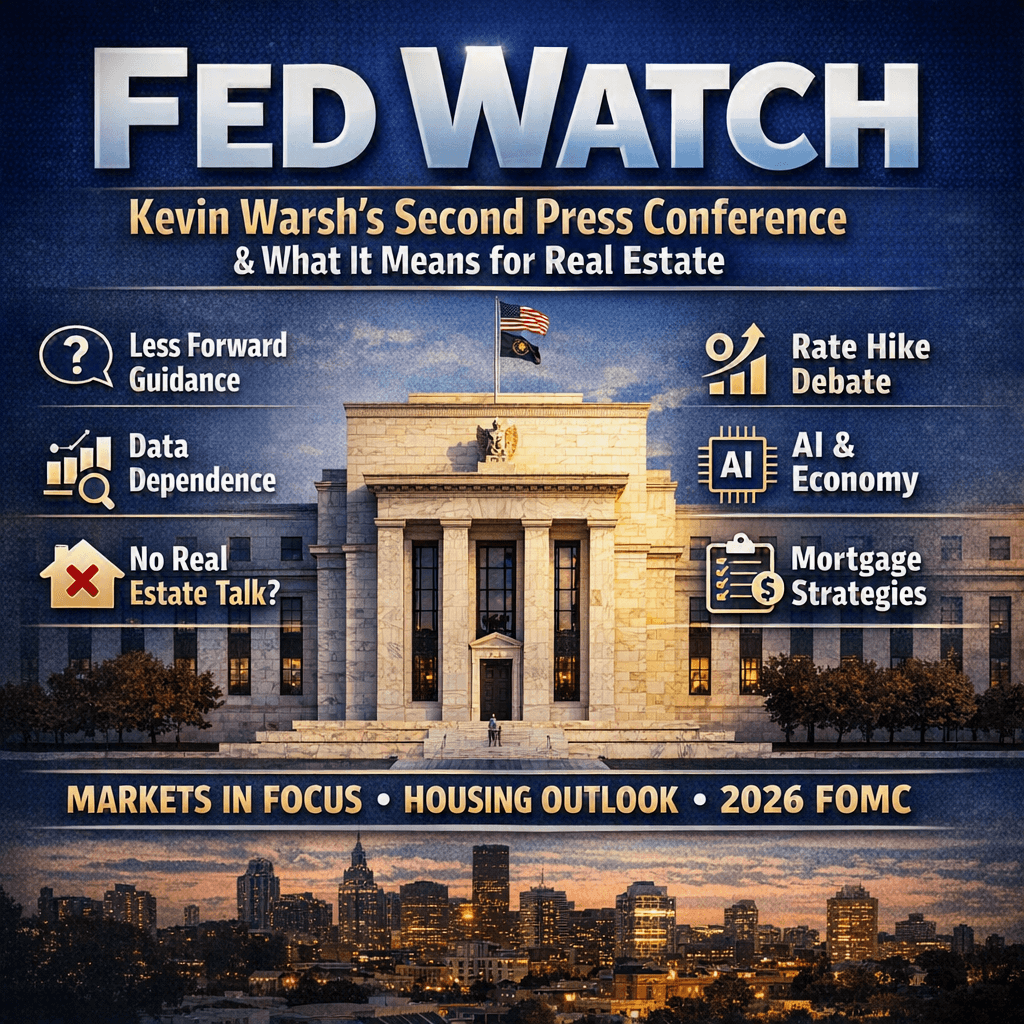
I encourage every homeowner, buyer, seller, investor, and real estate professional to listen to these press conferences. You do not need to be an economist. Yes, some of the language is technical, but the practical insights are valuable for anyone making decisions about real estate and generational wealth.
Warsh is deliberately offering less forward guidance than his predecessor. He has signaled that he prefers markets to debate and price risk themselves rather than relying on the Fed to act as referee. In his words (paraphrased), he wants a healthy “family fight” among market participants instead of the central bank dictating the narrative.
I welcome this approach. For years, many of us in the real estate and mortgage business have argued that heavy forward guidance and pure “data dependence” created distortions. Warsh’s memorable line captured it well: the problem with data dependence is both the data and the dependence. He has stood up task forces examining the reliability of traditional statistics versus newer, real-time measures. That is a constructive step.
The committee left rates unchanged. Three members dissented in favor of a 25-basis-point hike. Warsh spent time discussing the value of that internal debate. From my perspective, holding steady while the Fed works on better information is preferable to moving on data that many of us believe is incomplete or lagging.
Notably, real estate received almost no attention in the statement or press conference. The balance sheet also received only brief mention. The broader economy was described as stable and growing, driven significantly by technology and AI-related investment. That growth is real, yet it is occurring alongside a still K-shaped recovery: the top tier of households is doing relatively well while the middle continues to feel the pressure of higher costs and elevated tax burdens.
Real estate has historically played a major role in recoveries. Right now it is not the primary driver, and it is not receiving much airtime from the Fed. That does not mean the sector is unimportant—it means those of us who work in it must be more deliberate.
The next three meetings will be worth watching closely. The December 9 meeting includes the Summary of Economic Projections (SEP). Warsh has shown little enthusiasm for detailed forward-looking forecasts, so the tone and content of that release—and any accompanying discussion of the task-force work—will be telling. Jackson Hole is also on the calendar in August.
I remain cautiously optimistic that conditions can improve later this year and into next year, though external shocks (including geopolitical events) remain a real variable. Housing values continue to rise according to most major data sources. That means waiting does not automatically make homes more affordable; it often makes them more expensive.
Interest rates are no longer being held artificially low by large-scale Fed purchases of mortgage-backed securities. Getting the right loan structure now requires more skill:
The goal is not simply to close a loan. It is to put clients into financing that supports long-term ownership, equity growth, and the ability to pass real estate wealth to the next generation.
If you would like to talk through how the current environment affects a specific purchase, refinance, or investment strategy, call me directly at 720-419-3016. I enjoy these conversations. Honesty, clarity, and a clear explanation of the trade-offs are how lasting relationships—and good decisions—are built.
Mike Nelson, CEO - Efficient Lending, Inc
720.419.3016 | mike@efficientlending.net | @mike_lending
NMLS: 1876539 | NMLS: 1314188
#EfficientLending #MortgageRates #RealEstate #Mosaic
