Jobs Beat Expectations, Broader Labor Data Cools - MBS Highway 8-31-26 Update
Week of August 31, 2026: In review, August's jobs report came in much stronger than expected, even as other data pointed to a cooling labor market.
Here's what you need to know.
August Jobs Report Surprises to the Upside
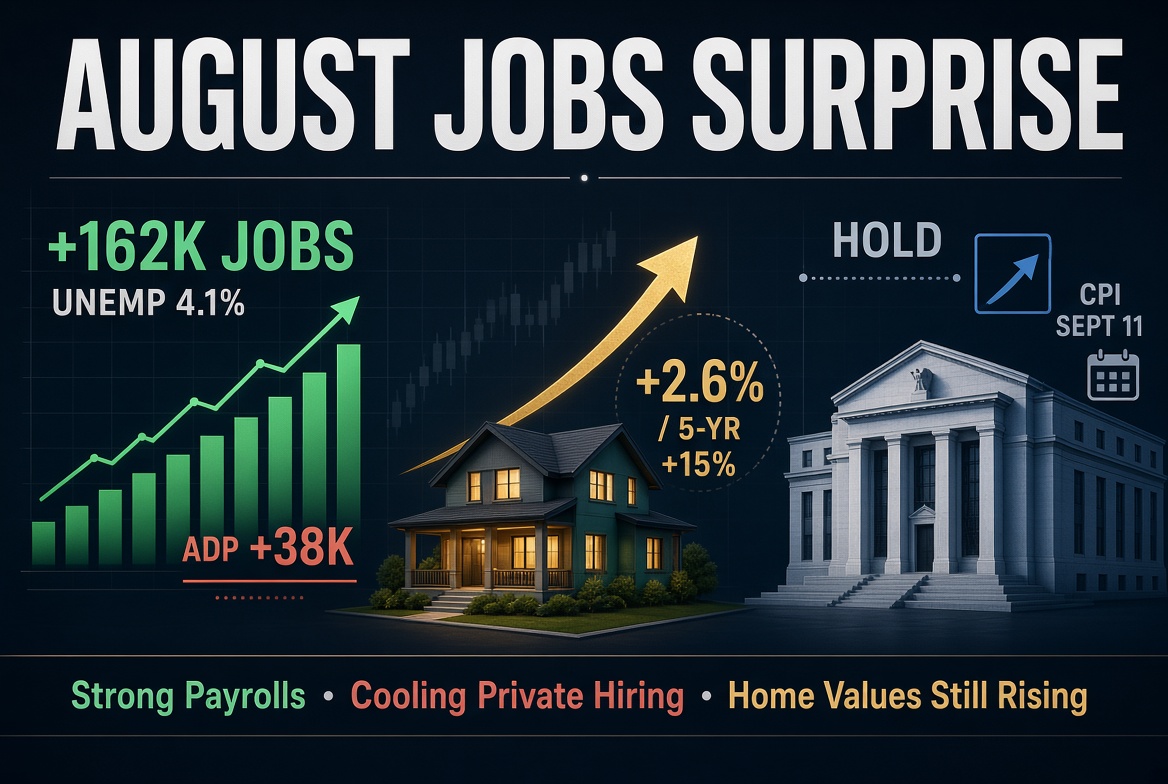
August hiring came in well above expectations, with the economy adding 162,000 jobs – nearly three times the expected gain. Payrolls for June and July were also revised higher by a combined 55,000 jobs. Much of that revision came from July, when the initial estimate of a 23,000-job decline was revised to a 21,000-job gain.
Meanwhile, the unemployment rate held steady at 4.1%.
Bottom line:
This was a strong report on several fronts, including some encouraging details beneath the headline number. Full-time employment rose by 735,000, while part-time employment fell by 223,000. Job gains were also strong in several areas, including a 62,000 increase in leisure and hospitality employment. Plus, the growth in the labor force helped the unemployment rate remain at 4.1% for the right reasons – not due to an exodus from the labor force.
However, there is an important caveat. Monthly BLS job numbers can be volatile and are often revised as more data becomes available. And this report looks stronger than several other measures of the labor market, including the latest data from ADP and Revelio Labs.
Private Sector Hiring Slows to Seven-Month Low
ADP's latest report painted a much softer picture than the government's jobs report. Private employers added just 38,000 jobs in August, below expectations of about 50,000 and well below the 127,000 private-sector gain reported by the BLS.
August marked ADP's slowest pace of private-sector job growth since January.
Large businesses accounted for most hiring, while smaller employers added workers more slowly. Among workers who changed jobs, pay rose an average of 7.3% over the past year, compared with 4.4% for workers who stayed with their current employer.
Bottom line:
Hiring remained concentrated in a relatively small number of industries, rather than spreading broadly across the economy. Education and health services accounted for much of the growth, reflecting longer-term demand for workers as the population ages rather than necessarily signaling a broad pickup in overall economic activity.
Other Reports Suggest the Labor Sector is Cooling
The ADP report wasn't the only sign that hiring is losing momentum.
Revelio Labs reported 36,500 job gains in August, with health care and social assistance among the key drivers, consistent with ADP's trends.
Job openings totaled 7.27 million in July, slightly below expectations of 7.3 million. June's openings were also revised lower by 177,000, to 7.18 million. The headline number may somewhat overstate the number of unique opportunities available to workers because some remote jobs are posted in multiple locations.
New unemployment claims remained relatively low at about 206,000, suggesting layoffs are still limited. But claims don't capture every worker who loses a job: some people may turn to gig or freelance work rather than file for unemployment benefits.
At the same time, continuing unemployment claims remained elevated at 1.78 million. That suggests workers who do lose their jobs may be taking longer to find new ones.
Bottom line:
The labor market is showing signs of cooling, while inflation is still above the Fed's 2% target. That leaves policymakers balancing two competing concerns as they weigh their next move on interest rates.
The Fed held rates steady at its July meeting, though three members dissented in favor of a quarter-point hike, citing concerns about inflation. More recently, Fed Chair Kevin Warsh stressed that if inflation doesn't make meaningful progress toward the Fed's 2% target, there is still "work to do." His comments keep the possibility of a rate hike on the table, but he stopped short of committing to one at the Fed's September meeting.
Governor Christopher Waller, meanwhile, said he is willing to hold rates steady if inflation progress continues. New York Fed President John Williams also said he believes the Fed's benchmark rate is in a good place.
Now, attention turns to the August CPI report, due September 11. That will be an important data point ahead of the Fed's September 15-16 meeting and could help determine whether the Fed stays on hold or considers a rate hike.
Appreciation Forecasts Highlight Value of Homeownership
Fannie Mae and Pulsenomics' latest Home Price Expectations Survey – which reflects forecasts from more than 150 economists, real estate experts, and market strategists – puts the median forecast for home price growth at about 2.6% over the next year and roughly 15% over five years. For a $500,000 home, that translates to around $13,000 in appreciation over the next 12 months and about $75,000 over five years, underscoring the potential for homeownership to build wealth over time.
What to Watch Ahead
After the market closures Monday for Labor Day, key reports are due late in the week. Thursday brings Existing Home Sales, weekly jobless claims, and wholesale inflation data via the Producer Price Index. The closely watched Consumer Price Index inflation data follows on Friday.
All data and analysis provided by MBS Highway.
Connect with me anytime to continue the dialogue.
Mike Nelson, Efficient Lending, Inc 720.419.3016 | mike@efficientlending.net |