I have the privilege of working in an industry that allows me to engage with real estate agents, buyers, sellers, and investors across these states, discussing mortgages, generational wealth, and building lasting legacies through real estate. I remain deeply passionate about this work.
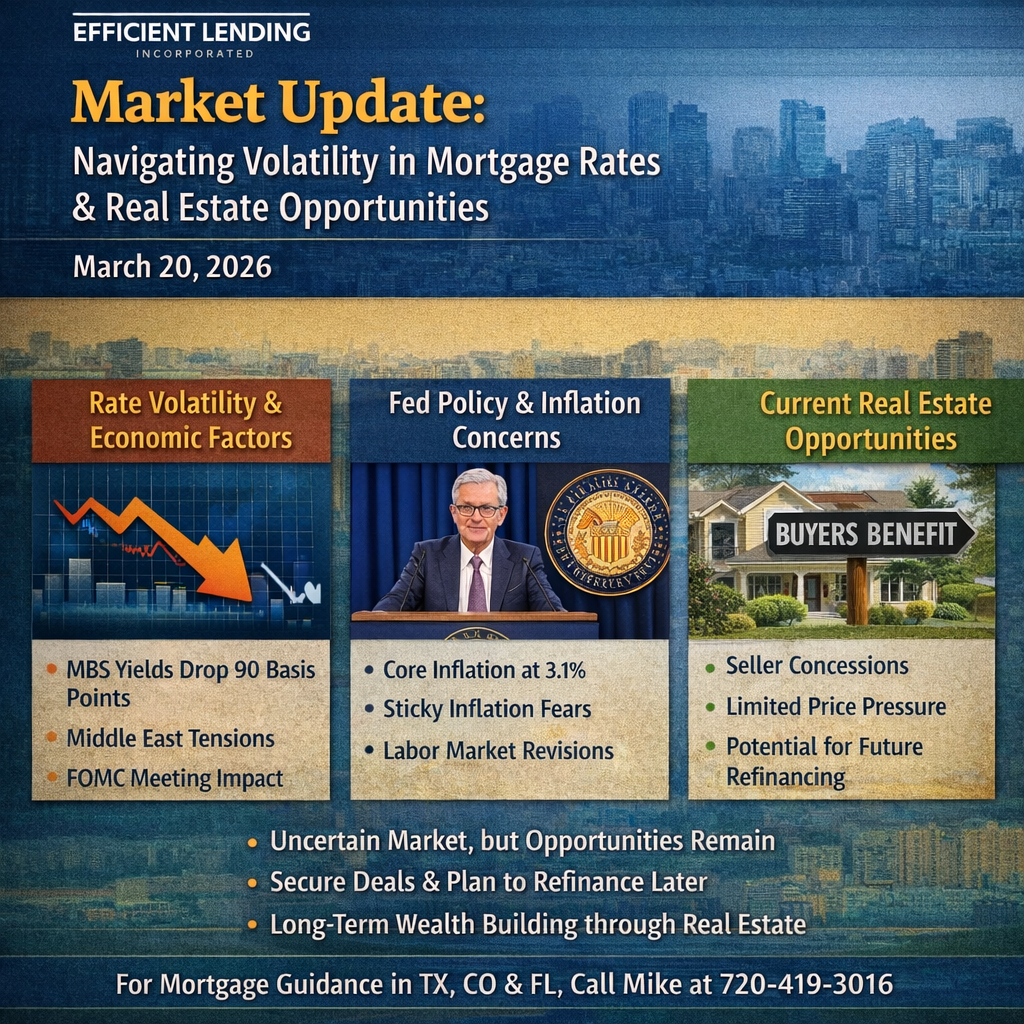
This week has been particularly volatile in the mortgage-backed securities (MBS) market and mortgage interest rates. As markets closed today, Friday, March 20, 2026, MBS yields declined by approximately 90 basis points.
To clarify, a drop in MBS yields corresponds to rising mortgage interest rates, representing a significant and noteworthy movement. While I cannot recall an identical single-day shift in my decade of close monitoring, this development carries clear implications for the housing market.
Several factors have contributed to recent challenges. Volatility intensified following the onset of conflict in the Middle East around March 2, influencing energy prices, inflation expectations, and broader economic sentiment. Additionally, the Federal Open Market Committee (FOMC) meeting this week, including Chair Jerome Powell's press conference, provided important insights into the direction of monetary policy.
The Federal Reserve maintains a dual mandate: price stability (targeting 2% inflation) and maximum employment. Recent data, including the core Personal Consumption Expenditures (PCE) price index—preferred by the Fed—showed a month-over-month increase, pushing the annual rate to approximately 3.1%. This upward trend in core inflation, which excludes volatile food and energy components, has heightened concerns about persistent ("sticky") inflation, reducing the likelihood of near-term rate cuts.
I approach these indicators with caution. While the Fed emphasizes core PCE, alternative sources such as Truflation suggest inflation may be overstated due to methodological issues in official calculations. Third-party data often reveal lower, more timely readings. Moreover, historical context is relevant: loose monetary policy during and after the pandemic contributed to elevated inflation, a predictable outcome that has proven difficult to reverse.
Labor market data also warrant scrutiny. Official Bureau of Labor Statistics (BLS) figures have undergone significant downward revisions, including the removal of nearly 1 million jobs in late 2025 and additional adjustments in early 2026. Alternative sources, such as ADP reports, provide a more consistent view. Chair Powell highlighted labor market stability in his remarks, yet these revisions raise questions about the underlying strength.
Despite current headwinds, I view the present environment as presenting meaningful opportunities in real estate. The housing sector remains relatively weak amid broader economic expansion (with GDP growth in the 2% range). If inflation proves overstated and the Fed eventually adjusts policy—potentially under new leadership following the transition in May—pent-up demand could be released. A resolution to the Middle East conflict would further alleviate pressure on energy costs and inflation, supporting a quicker recovery.
Buyers currently benefit from limited price pressure, with sellers offering significant concessions, including contributions toward closing costs, rate buydowns, appraisals, and inspections—in sharp contrast to the competitive conditions of recent years.
My advice remains straightforward: If a property aligns with your needs—whether for a primary residence, an investment, or a move-up—proceed with the purchase. Secure favorable terms now, including seller concessions, and position yourself to refinance when conditions improve. Historical patterns indicate that nearly all mortgages are refinanced or the property sold within 7–10 years, regardless of the initial rate.
Broader risks persist, notably the national debt exceeding $38 trillion and ongoing fiscal imbalances, which could exert inflationary pressure through increased Treasury issuance. I monitor these dynamics closely, alongside Fed communications, third-party data, and geopolitical developments.
This is not a political discussion; my focus is on factual trends and actionable strategies for building wealth through real estate. Peace in the Middle East is essential, and I extend empathy to all affected by loss of life or hardship.
For those in Colorado, Texas, or Florida exploring mortgage options, generational wealth strategies, or market insights, please contact me at
