The buyers who are still shopping care about one number above all: the monthly payment. So when a seller is ready to give up $10,000, the real question is how to spend it so the deal actually closes.
· Sellers gave concessions in 44.7% of U.S. home sales in the three months ending in August. That’s the highest share for that period since at least 2020 (Redfin).
· About 15% of buyers got both a concession and a price cut (same source).
· The median sale price fell 0.4% year over year in October, the first decline since May 2023 (Redfin, Nov 10).
· The 30-year fixed averaged 7.11% on Nov 12 (Freddie Mac PMMS).
Sellers already expect to give something. Your edge comes from showing them which option does the most for the buyer.
These are illustrative numbers, not a quote: a $400,000 purchase with 20% down, a 30-year fixed at 7.11%, principal-and-interest-only.
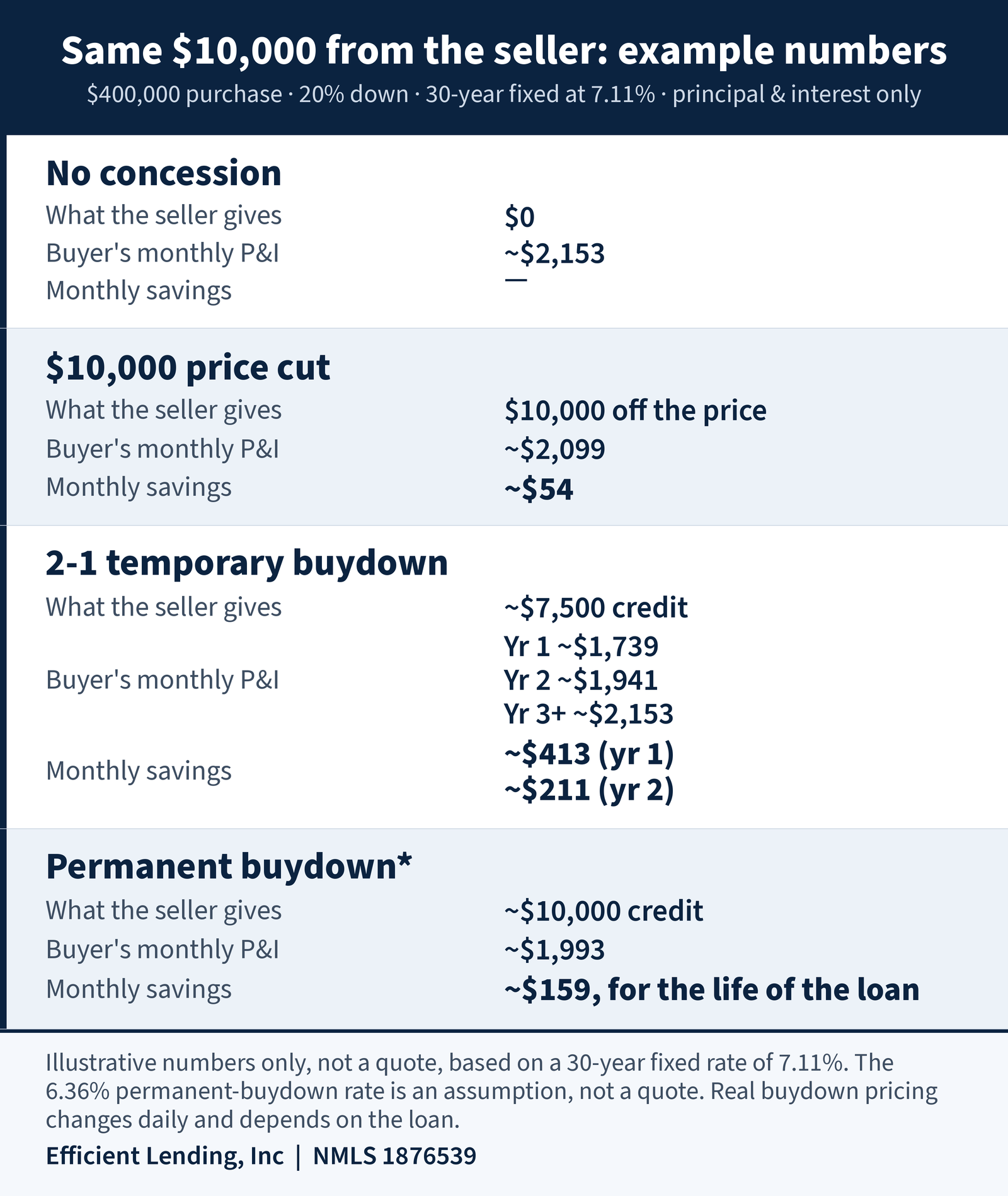
The takeaway: in this example, the same money saves the buyer roughly 3 to 8 times more each month as a rate buydown than as a price cut. On the 2-1 option, the roughly $2,500 left over can go toward closing costs.
· Appraisal or comp risk. If the contract price is already stretching the comps, a lower price protects the deal.
· Cash-heavy or large-down-payment buyers. If they barely finance, a buydown does little.
· Future comps. Some sellers and listing agents want the recorded price to reflect the market.
· Payment-sensitive and first-time buyers who need the debt-to-income ratio or monthly budget to work.
· Buyers who expect to keep the loan a while. A permanent buydown pays off the longer they keep it.
· Buyers who expect to refinance. A 2-1 lowers the payment in the early years while they wait. (I won’t promise rates will drop, and you shouldn’t either.)
Keep in mind that seller concessions are capped by the loan program and down payment. Conventional, FHA, and VA each have their own limits, so check with me before you write the number into an offer.
1. Net-to-seller stays about the same. $10,000 off the price and a $10,000 credit both come out of the seller’s proceeds.
2. More buyers can afford the listing. Advertising a lower payment brings in buyers who qualify by payment, not by price.
3. Market it: “Seller will contribute toward a rate buydown. Ask how much lower your payment could be.”
Futures markets are pricing in a near-certain Fed rate hike at the December 8–9 FOMC meeting (MPA, Nov 10). The Fed doesn’t set mortgage rates directly, but uncertainty makes buyers hesitate. A locked rate with a seller-paid buydown gives buyers a known payment, which keeps deals moving.
Send me a listing or an active buyer, and I’ll build a side-by-side comparison of a price cut, a 2-1 buydown, and a permanent buydown within 24 hours. It’s a clean one-page sheet you can bring to your seller or buyer.
👉 Request a buydown comparison at efficientlending.net
Mike Nelson | Efficient Lending, Inc | NMLS 1876539 | Equal Housing Opportunity. This is for information only and isn’t a commitment to lend. All loans are subject to credit approval, underwriting guidelines, and program availability. Rates, terms, and fees can change without notice. Examples are for illustration only.
