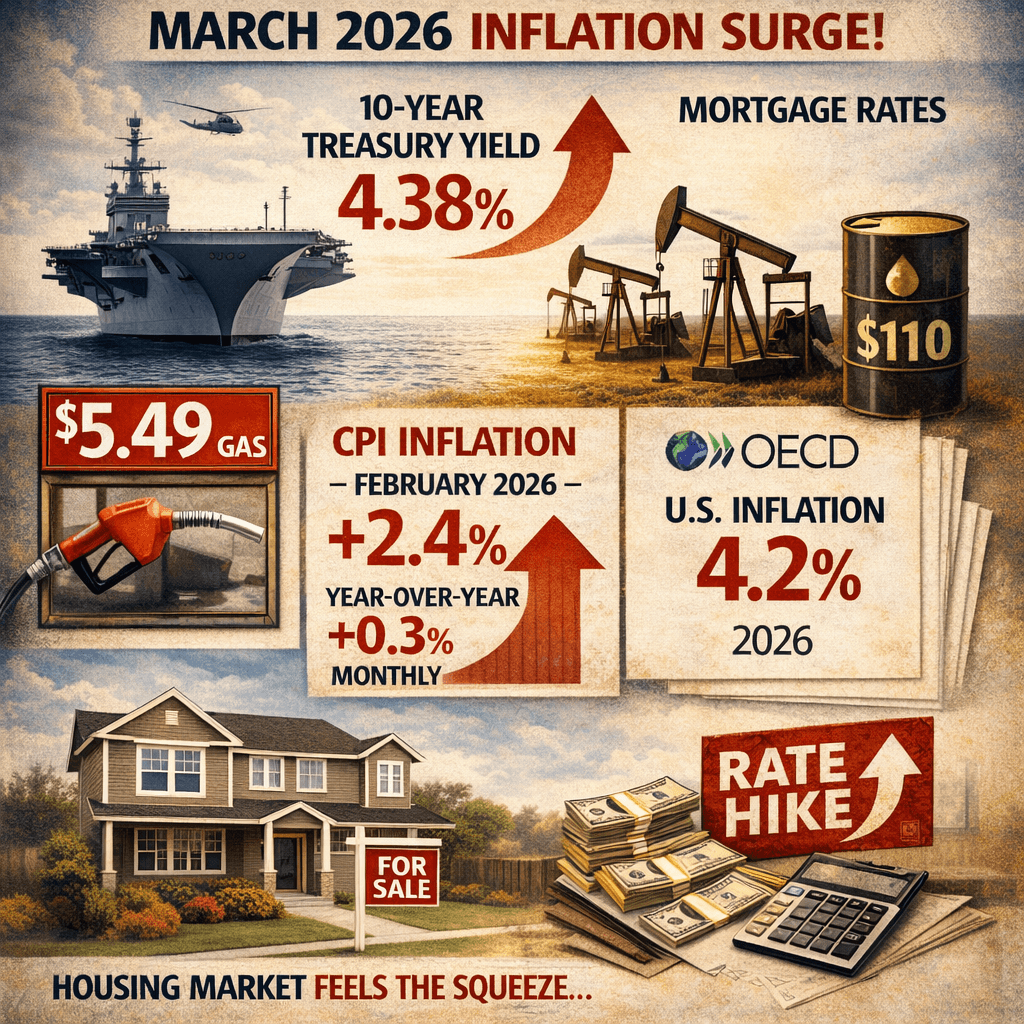
Let’s start with the “why.” Mortgage rates don’t move in a vacuum. They closely track the 10-year U.S. Treasury yield, which investors adjust in response to inflation expectations and global risks. In late February and throughout March 2026, the escalation in the Middle East—particularly disruptions to oil shipments through the Strait of Hormuz—sent energy prices soaring. Oil surged well above $110 per barrel at points, the highest levels since 2022.
Higher energy costs ripple through everything: gasoline, groceries, shipping, and manufacturing. This created a classic supply-shock inflation fear, driving Treasury yields up from under 4% to around 4.38%. As a direct result, the average 30-year fixed mortgage rate climbed from roughly 6.1–6.2% at the end of February to 6.38–6.44% by late March, according to Freddie Mac and Bankrate data—the highest levels since last fall.
The numbers back this up clearly. The February 2026 Consumer Price Index (CPI) rose 2.4% year-over-year, matching January’s reading and marking the lowest annual pace in five years. Core CPI (excluding food and energy) was 2.5%. On a monthly basis, CPI increased 0.3%. These figures were released on March 11, right as the full energy shock from the conflict was hitting.
The Personal Consumption Expenditures (PCE) price index—the Federal Reserve’s preferred gauge—stood at about 2.8% year-over-year in January, with similar trends expected in the February data. Labor market reports showed steady, though not red-hot, job growth, with early signs of softening in February payrolls. Normally, cooler labor data might ease rate pressure, but fears of energy-driven inflation overrode that.
The Organization for Economic Cooperation and Development (OECD) even revised its 2026 U.S. inflation forecast upward to 4.2%, citing the war’s impact on energy supplies.
In short, the conflict created real uncertainty, bond investors demanded higher yields to offset inflation risk, and mortgage rates followed. This isn’t speculation—it’s how the market works, and at Efficient Lending, we always walk you through these nuances so you understand exactly why your rate quote looks the way it does.
Now, let’s talk about the broader market and what’s ahead.
The spring buying season got off to a slower start due to higher borrowing costs, and affordability remains a challenge for many families. Yet the housing market itself is resilient—inventory is still tight in many areas across Colorado, Texas, and Florida, and home values continue to support long-term wealth building.
The Federal Reserve has held its benchmark rate steady, prioritizing inflation control over immediate cuts, which keeps mortgage rates anchored higher for now.
Looking to the next several months (through summer and into fall 2026), most forecasts point to rates staying range-bound in the low-to-mid 6% range.
The Mortgage Bankers Association and Fannie Mae see 30-year fixed rates averaging around 6.1–6.3% for much of the year, with Fannie projecting a possible dip toward the upper 5s by year-end if the conflict de-escalates and energy prices stabilize. There’s upside risk if oil stays elevated or inflation proves stickier, but also downside potential if cooler labor data or progress on the geopolitical front eases bond-market fears. Volatility is likely—rates could swing week to week—but the direction isn’t a straight line upward.
Here’s the part I want every reader to hear loud and clear:
This moment doesn’t change the power of real estate to build generational wealth and legacy. At Efficient Lending, we specialize in finding the low-cost mortgage that truly fits your unique situation—whether you’re buying your first home in Denver or Austin, refinancing in Miami or Fort Worth, or investing for the long haul. We pick up the phone, listen to your goals, explain every option with full transparency, and structure loans that save you money over time.
Higher rates today don’t mean you should sit on the sidelines. They mean working with a trusted partner who can help you lock in the best available rate, explore adjustable options if they make sense, or time your move strategically.
I’ve built Efficient Lending on relationships that last for decades—many of you have become friends, not just clients. That’s why we’re here in Colorado, Texas, and Florida, ready to guide you through whatever the market throws our way.
If you’re thinking about buying, refinancing, or simply want a straightforward conversation about how these rate movements affect your plans, reach out today.
Call us, email, or connect on X at @mike_lending.
And if you haven’t yet, check out my podcast Mosaic: The Stories of Real Estate—the intro episode is live on Spotify—where we explore exactly how families like yours are creating lasting legacies through smart real estate moves.
Mike Nelson Owner, Efficient Lending, Inc. (NMLS: 1876539)
720.419.3016 | mike@efficientlending.net | @mike_lending Serving Colorado, Texas, and Florida with honesty, integrity, and real results.
