The Housing Market Is Changing: Why Smart Buyers and Investors Should Pay Attention Now
My name is Mike Nelson, CEO of Efficient Lending, Inc., headquartered in Waco, Texas. We originate residential mortgages in Colorado, Texas, and Florida. I love working across these three states with buyers, sellers, agents, title companies, and everyone involved in real estate.Today’s focus is a simple but powerful truth: the housing market is changing, and smart buyers and investors should pay attention. It has been a while since my last Mosaic post (the September 9th episode ahead of the Fed meeting and CPI). Markets have been volatile, and I wanted a clearer perspective. That clarity is here now.
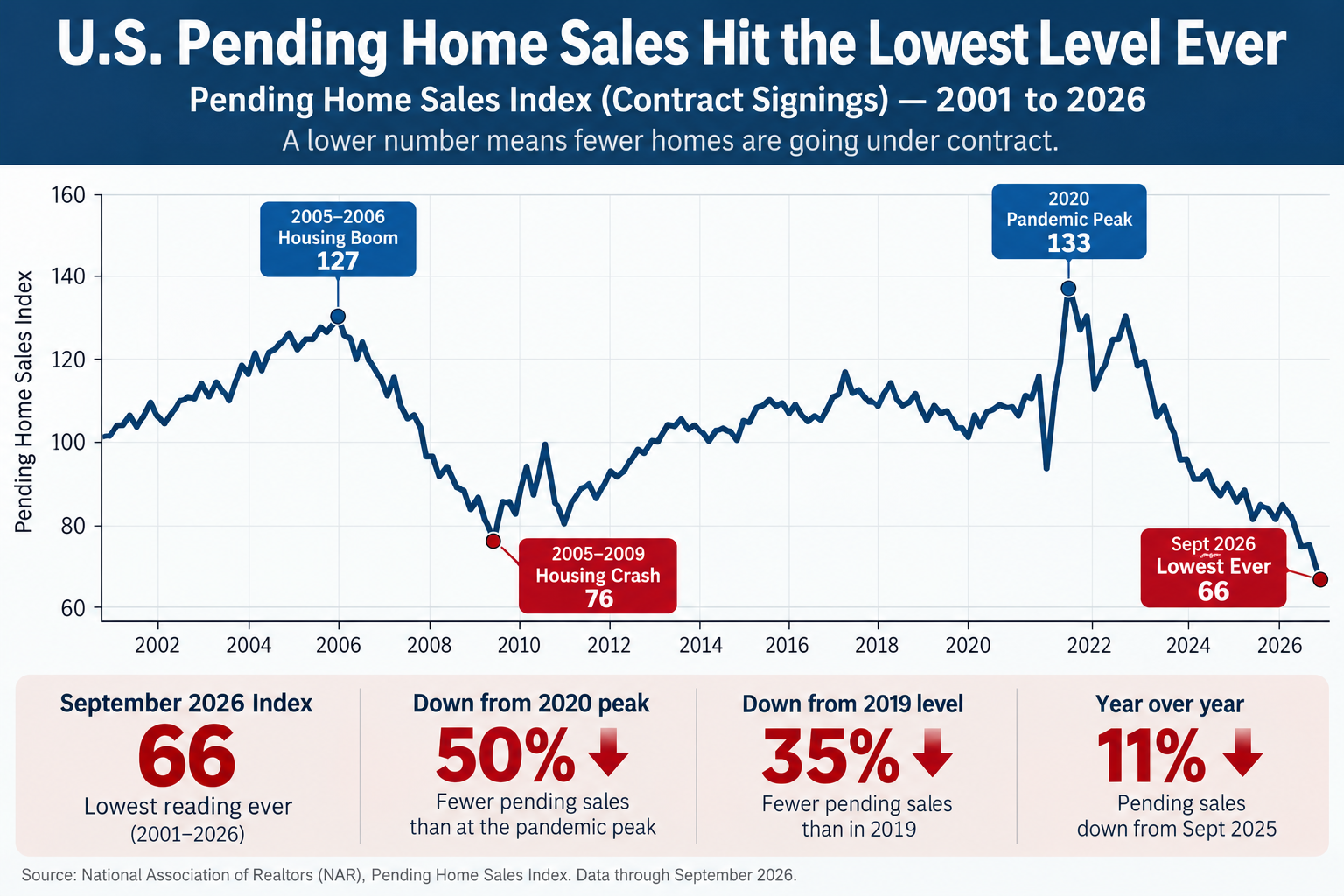
Pending Home Sales Hit a Record Low
The National Association of Realtors (NAR) Pending Home Sales Index for September 2026 came in at 66.0—the lowest reading since the series began in 2001. An index of 100 is neutral. Below 100 signals declining contract activity.
For context:
• 2020 peak: near 133 • Mid-2000s boom: around 127 • Previous low during the housing crash: about 76 • Today: 66 — roughly 50% below the 2020 peak, about 35% below 2019 levels, and down ~11% year-over-year
This is a dramatic slowdown. It lines up with higher mortgage rates, but it also puts us in a buyer’s market in terms of negotiating power. Sellers who need to move still have reasons to sell (job changes, life events, rightsizing), yet the dynamic is very different from the pandemic peak.
Home Prices Remain Surprisingly Resilient
Despite the drop in pending sales and higher rates, home prices have held up better than many expected. The Case-Shiller National Index rose 2.1% year-over-year in August 2026, while the FHFA House Price Index showed roughly 2.4% annual growth. Modest gains in a high-rate environment.
I don't know whether this continues or whether some markets eventually correct more sharply. Slower volume plus modest price resilience creates interesting opportunities.
The Bond Market, National Debt, and Mortgage Rates
Real estate is tightly connected to the 10-year U.S. Treasury. Mortgage rates are generally the 10-year plus a spread (influenced by MBS, servicing, and other factors). The 10-year is the global benchmark for the cost of money and has been volatile and elevated.
The United States carries roughly $40+ trillion in national debt. Servicing that debt is a major budget item. Selling Treasuries and taxation are primary tools—and both have inflationary implications that flow into rates. Global capital flows and other events add volatility.
If you are involved in real estate, keep the 10-year, the mortgage spread, and U.S. debt dynamics in view. Ignoring them weakens your strategy.
What This Means for Buyers and Sellers: Negotiation Is More Than Price
In a financed purchase, the lowest purchase price is not always the lowest total cost. Seller concessions (interested party contributions / IPCs), rate buydowns, ARMs, flexible closing dates, and other terms can change the math dramatically.
From conversations with agents across Colorado, Texas, and Florida, I am seeing offers near asking price paired with meaningful concessions for closing costs or buydowns. In some scenarios, paying the full asking price with a sizable seller concession beats a lower price with no help.
Key points:
• Fannie Mae and Freddie Mac limit IPCs based on property type, occupancy, and other factors. Work with an experienced agent and lender who know the rules. • Motivated sellers are more likely to be flexible. • Cash buyers still focus mainly on price; financed buyers have more levers.
Appraisal/inspection waivers and bidding over ask were common in 2020. They are rare now. Seller concessions and term flexibility are back. That is a meaningful shift.
The Cost of Waiting
Higher rates alone are not always a reason to wait. In many cases, the cost of waiting (price movement in resilient markets, opportunity cost, or life timing) can outweigh the hope of lower rates later. Local conditions in Colorado, Texas, and Florida vary, and every situation is unique.
The advantage goes to buyers, sellers, and agents who work with a lender who can run the real long-term numbers—price reduction vs. concessions, permanent vs. temporary buydowns, ARM vs. fixed, and the impact on cash flow and equity building. Generational wealth in real estate usually comes from thoughtful financing and execution, not perfect market timing.
Final Thoughts
The housing market is changing. Pending sales are at a 25-year low, giving buyers leverage on terms even as prices show resilience. Macro forces around debt and rates still matter. Smart buyers, investors, sellers, and agents who understand negotiation beyond price alone—and partner with the right team—can find real opportunities.
If you are in Colorado, Texas, or Florida and want to talk through your situation, call or text me at 720-419-3016.
Thanks for reading. I hope you have a great day and enjoy the fall.