The Power of Term: Why the Length of Your Mortgage Matters More Than You Think
At Efficient Lending, we exist to help families and individuals in Colorado, Texas, and Florida acquire generational wealth and lasting legacies through real estate. Markets are volatile right now. Confusion is high. And properly purchasing—or refinancing—a home requires both the skill of a good real estate professional and a clear understanding of mortgage math.
Last week on the Mosaic podcast, I talked about the true cost of waiting for rates to fall. This week I want to dig into something even more powerful and far more misunderstood: term—the length of your loan.
The number-one weapon for driving the cost of a mortgage down is not the interest rate. It is time.
Stop Looking at a Mortgage as a Single Point in Time
Most conversations I have with buyers and homeowners center on one question: “What’s the interest rate today?” People treat the cost of the mortgage as if it is set the day they lock the rate and close.
That is not how mortgages work.
Nearly every mortgage in the United States is retired—sold or refinanced—by year ten. In eleven years of originating loans, I can barely remember seeing a mortgage still standing past the ten-year mark. Statistically, you will refinance or sell long before the original term ends.
That reality changes everything. Instead of focusing only on the rate you lock today, you should be focused on the principal balance remaining at years five, seven, and ten. Those are the points at which most loans disappear. The lower that remaining balance, the more equity you keep—and the stronger your position when you refinance or sell.
How Amortization Actually Works
On a typical 30-year fixed loan, you will pay roughly 75% of the total interest in the first fifteen years. In the early years, the vast majority of every payment goes to interest. Only later does the principal portion grow.
This is the relationship we want to leverage. By shortening the term—even by a year or two—we direct more of each payment toward the principal earlier, resulting in significantly lower balances at the five-, seven-, and ten-year marks.
A Real-World Example (Illustrative Only)
Important disclaimer: The interest rate used below (6.5%) is for illustration only. It is not an advertised rate, not a quote, and may not even exist when you read this. Do not call asking for “the 6.5% rate from the podcast.” This is purely a teaching example.
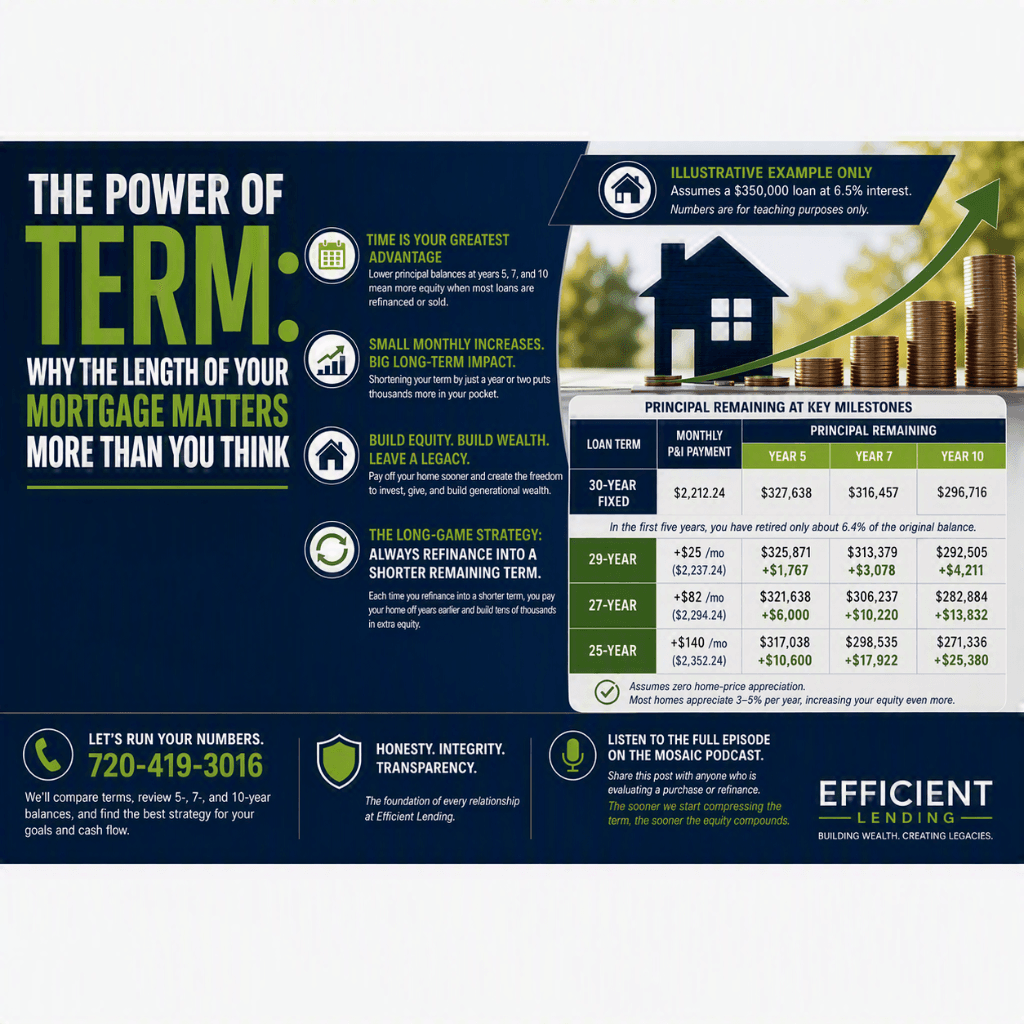
Assume a $350,000 loan amount at 6.5%.
30-Year Fixed
• Monthly principal & interest payment: $2,212.24 • Principal remaining at Year 5: $327,638 • Principal remaining at Year 7: $316,457 • Principal remaining at Year 10: $296,716
In the first five years, you have retired only about 6.4% of the original balance. The principal paydown accelerates meaningfully between years five and ten—another reason the ten-year horizon matters most.
Now shorten the term by just one year — a 29-year loan
• Monthly payment increases by only $25 • At Year 5, you have $1,767 more equity than the 30-year fixed • At Year 10, you have $4,211 more equity than the 30-year fixed
Twenty-five dollars a month is two or three cups of coffee. In exchange, you put real money in your pocket at the exact points when most people refinance or sell. And remember: these numbers assume zero home-price appreciation. In reality, most homes still appreciate by 3–5% per year, even in tougher markets, so the equity advantage is even greater.
Shorten further
• 27-year loan: payment up ~$82/month → roughly $6,000 more equity at Year 5 and nearly $14,000 more at Year 10 than the 30-year fixed. • 25-year loan: payment up ~$140/month → about $10,600 more equity at Year 5 and more than $25,000 more equity at Year 10 than the 30-year fixed.
The Long-Game Strategy: Always Refinance into a Shorter Remaining Term
If cash flow today requires a full 30-year term, take it. There is no shame in that. But when rates allow you to refinance, do not simply restart another 30-year clock. Look at where you are on the current amortization schedule and refinance into a term shorter than the remaining term.
Do this repeatedly over time, and you will pay the house off years earlier than the original schedule. That difference is tens of thousands of dollars of realized equity—money that can become investment properties, education funds, or simply a paid-off home that forms the foundation of generational wealth.
The goal is not the lowest possible payment on day one. The goal is the highest payment you can comfortably sleep with on the shortest term that still fits your life. A loan officer who understands this math—and is willing to walk through it with you on the phone—makes all the difference.
This Is Subtle. Let’s Talk Through It.
These concepts are nuanced. Numbers on a page or in a podcast can feel abstract until you see them applied to your own situation. That is exactly the conversation I love having.
Call me at 720-419-3016. We will run the numbers on your actual loan or purchase scenario, look at the five-, seven-, and ten-year principal balances, and find the term that best supports both your monthly cash flow and your long-term wealth goals.
Honesty, integrity, and transparency are the foundation of every relationship at Efficient Lending. Explaining the quiet power of term is one of the best ways I know to live those values.
Listen to the full episode on the Mosaic podcast, and feel free to share this post with anyone who is evaluating a purchase or refinance. The sooner we start compressing the term, the sooner the equity compounds.
Mike Nelson,CEO, Efficient Lending, Inc. 720.419.3016 | mike@efficientlending.net |